
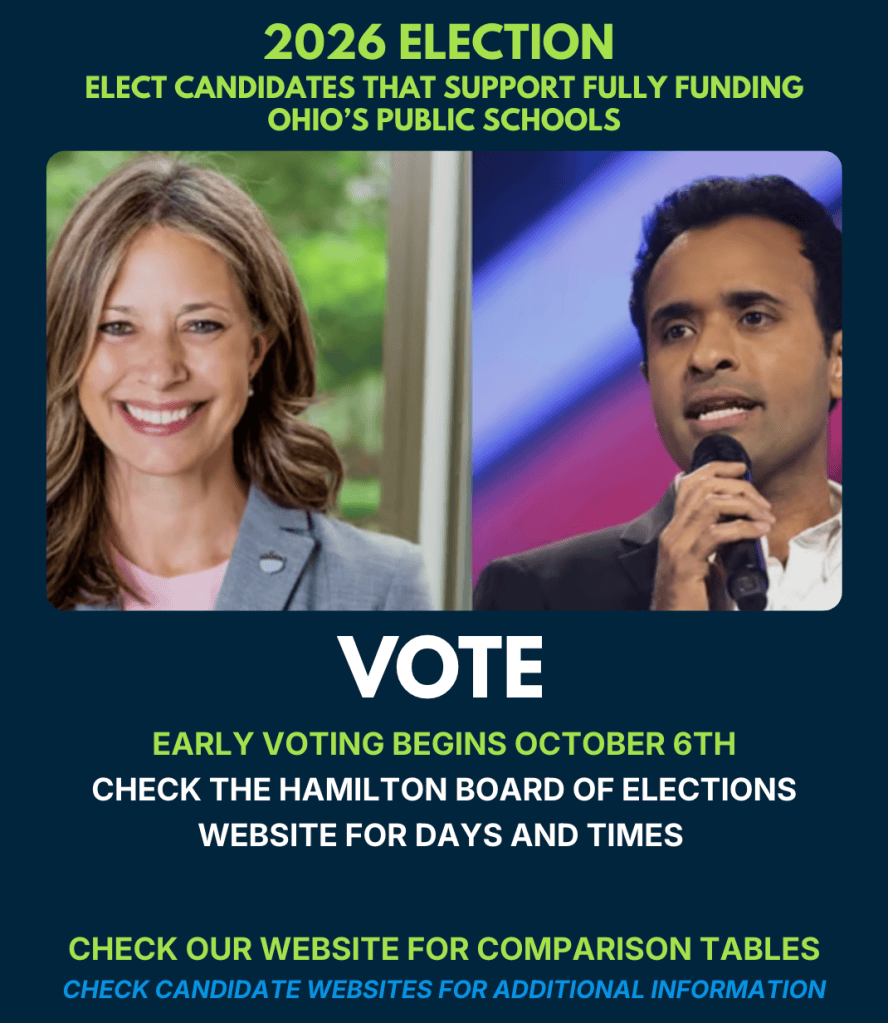
Comparing candidates positions on Educational topics
| Key Topic in Public Education | Amy Acton’s position (See official site & wording) | Vivek Ramaswamy’s position (See official site & wording) |
| School Funding & Resources | Focuses on increasing and fully funding public education upfront so districts have the resources needed to improve. (See Source) | Argues that public schools must demonstrate academic improvements and deliver outcomes before receiving increased financial support. (See Source) |
| Private School Vouchers | Seeks strict reform and control over private school vouchers to redirect public savings back into public classrooms. (See Source) | Advocates for universal school choice, expanding state-funded options to include private schools and homeschooling. (See Source) |
| Teachers & Unions | Endorsed by major teachers’ unions (OEA and OFT); defends collective bargaining rights for educators. (OFT announcement)(OEA announcement) | Skeptical of teachers’ unions; open to eliminating collective bargaining and pushing for local autonomy in setting compensation. (See Source) |
| Teacher Pay Structure | Retains standard funding models tied to district support and collective bargaining agreements. (See Source) | Proposes merit-based performance pay for teachers, principals, and administrators based on outcomes, peer reviews, and feedback. (See Source) (See VR’s Op Ed) |
| High School Graduation Requirements | Focuses on core support, reducing class sizes, and universal free breakfast/lunch rather than adding specific standardized exit exams. (See Source) | Proposes requiring high school seniors to pass the official U.S. civics test required for naturalized citizens to graduate.(See Source) |
| School Calendar & Hours | Criticized year-round schooling proposals as budget-drainers that strain public resources. (See Source) | Previously floated year-round schooling and longer days (7 a.m. to 4 p.m.) to help ease child care costs. He edited the video but has not made a declarative statement on a change to this position. (See Source) |
TL;DR
Ohio Capital Journal article comparing both platforms
Acton prioritizes restoring constitutional public school funding, increasing accountability for private vouchers to ensure similar transparency of spending and acceptance of all students of all abilities as public schools are required to do, and investing directly in traditional public classrooms.
Ramaswamy advocates for strict academic baselines, universal “school choice” (use of vouchers for all), and merit-based compensation for educators & administrators before any new funding from the state is allocated.
School Funding and Resources & Private School Vouchers:
Amy Acton’s position on School Funding
Dr. Amy Acton’s website for her campaign say that every child in Ohio deserves a fully funded, world-class public education, viewing public schools as life-saving hubs for our communities. As a mom of six children and the spouse of a lifelong public school teacher, Acton’s educational platform is deeply personal and focuses on shifting the financial burden away from household property taxes and back into our classrooms
Here are the details she posits to fully resource our schools and support our families:
- Fully fund local classrooms. Acton vows to fully implement the Bipartisan Fair School Funding Plan to give public schools the predictable state support they need.
- Relieve household property taxes. By restoring state funding to a constitutional level, she aims to stop forcing local communities to rely on constant, stressful school tax levies.
- Provide free school meals. She supports providing free breakfast and lunch for students. She frequently states that hungry kids cannot learn.
- Reduce class sizes. She wants to give teachers more resources and smaller rosters so they can focus on individual student needs.
- Reform private school vouchers. Acton plans to crack down on the current private school voucher system. She demands strict transparency and financial accountability for taxpayer funds.
- Protect public school budgets. She strongly opposed proposals for mandatory year-round school schedules. Her campaign emphasizes that such changes create massive deficits in school budgets.
- Upgrade math and reading programs. Her plan prioritizes investing in 21st-century, evidence-based math and literacy tools.
Vivek Ramaswamy’s position on school funding
As a candidate in the 2026 Ohio gubernatorial race, his core philosophy is that school systems do not suffer from a lack of funding, but rather from a lack of high standards and localized choice. He believes that public money should follow the individual child, allowing families to use tax-funded resources for the schooling method of their preference.
Funding the Child, Not the System
- Universal School Choice: Ramaswamy wants public education funds to act like a voucher system. Money follows your kids to public, private, or homeschool settings.
- Dismantling Top-Down Control: He advocates for shutting down federal oversight, shifting all remaining resource allocation to the state and local levels.
- Opposition to Tax Shortfalls: While critics argue his plans to eliminate state income tax could leave a multibillion-dollar hole in public school budgets, Ramaswamy maintains that shrinking the administrative bureaucracy will save money and shield local taxpayers.
Shifting Classroom Resources
- Performance-Based Pay: Instead of seniority-based structures favored by unions, he wants local school boards and principals to have the power to award merit pay to the best-performing teachers.
- Core Academics First: Ramaswamy argues resources are currently wasted on “woke” administrative initiatives. He wants money refocused strictly on basic math, physical fitness, and reading curriculum.
- No Class Phones: Part of his resource strategy includes banning cell phones from classrooms to restore student focus back to real-world learning
- NOTE: This was already enacted in Ohio – See ODEW info here
Details of Ramaswamy’s High School Graduation Requirements:
Core Components of the Proposal
- The Voting Requirement: Young citizens would need to pass the same civics exam administered to immigrants seeking naturalization.
- Alternative Service: Fulfilling the requirement could alternatively be met through six months of recognized public service, such as military or first-responder work.
- Age/Voting Contingency: Those who did not fulfill the test or service requirement by age 18 would face a delayed voting eligibility age of 25 for their first general election.
- Stated Intent: Ramaswamy argued the policy would incentivize civic knowledge, foster shared national identity, and encourage young adults to actively “earn” their civic responsibilities rather than view voting as an unconditional default right.
Public Reaction and Debate
- Critics: Opponents noted that adding a barrier to the constitutional right to vote likely violates the 26th Amendment (which sets the voting age at 18) and would require a complex constitutional amendment. Others argued that restricting or penalizing young adult voters is counterproductive to democratic participation. Supporters: Proponents and free-market/conservative commentators agreed that baseline civic literacy has dropped significantly in the U.S. and praised the idea of elevating the value of citizenship and public service.
Vivek Ramaswamy first heavily emphasized his position on vouchers during his 2024 presidential campaign (such as in January 2024) and reiterated it during his Ohio gubernatorial campaign rollout in February 2025 and subsequent policy forums (such as in August 2025), where he advocated for “universal school choice” including private options and homeschooling.,


Leave a comment