
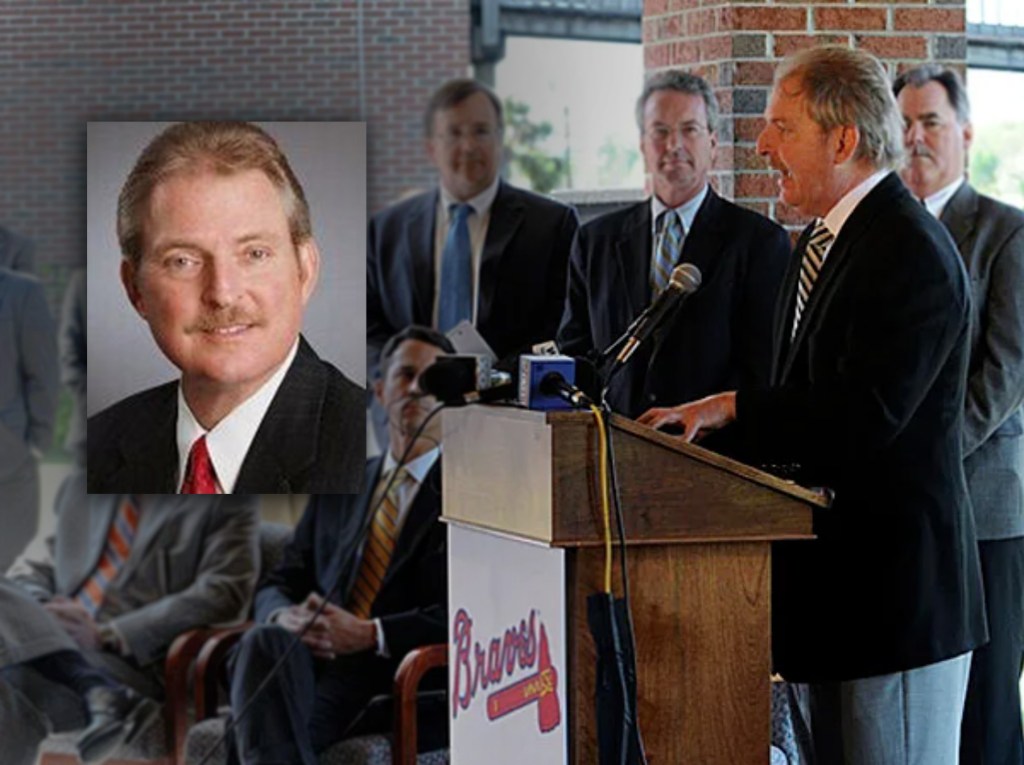

Anderson resident and former FHSD Board Member Rich Neuman has decades of experience in deal-making. As President of Baseball Development for Mandalay Baseball Properties and then as a VP of Major Accounts for Brailsford & Dunlavey, he pitched communities on new/renovated sports facilities and negotiated millions of dollars in sponsorships, naming rights, etc . He also was/is an expert in relationship development and innovative proposals that use a mixture of public and private funds (and optimistic revenue projections) to secure financing.
Now, as a consultant for Elevar Design Group (formerly SFA Architects), Neumann has proposed the sale of Anderson High School for private, mixed-use development. High school students would move to the “Bartels campus,” and elementary students would be reshuffled as part of a consolidation. Innovative, indeed.
To succeed in deal-making one must be persistent, and Neumann is nothing if not persistent. In fact, he attempted to consolidate the two FHSD high schools in 2010 when he was on the school board, and was involved in an earlier more detailed study in 2005.
During that scheme, he and others were sued for closed door meetings that were subject to sunshine law. Once the Cincinnati Enquirer’s lawsuit brought the issue to light, public meetings were held and the community responded that no—they did not want to consolidate high schools.
In 2015, he brought forward another plan to sell Anderson High School: “The Plan that Makes Too Much Sense“. Many of the players involved in 2015 are the same players involved now: Neuman, Tom Fernandez of Elevar/SFA, Andrew Brossart of Bradley Payne Advisors (formerly with 5/3 Securities), etc. As part of the 2015 plan, Anderson High School would have sold for a dollar as part of a multi-part land swap placing a new high school on Beech Acres property. Ultimately, all parties agreed that deal was not feasible. Notably, the plan would use the $25 million earmarked for Anderson renovations toward the new school.
The Anatomy of a Rich Neumann Development Proposal:
We reviewed hundreds of news articles and dozens of public records about Neumann’s prior deals with municipalities across the US (and even Ottawa, CA). We discovered a few themes with notable similarities to “Project Intrepid.”
1) Sense of Urgency
As an expert in minor league baseball and other pro sports, Neumann often invoked a tight timeline, citing the demands of professional sports teams that might move to/away from a particular municipality for a better sports facility.


Amarillo, TX:
Quotes from Star Amarillo Globe-News story “AA Basebal Team and High-Dollar Park?”


2) Secrecy
Atlanta, GA:
“Operation Intrepid” (sound familiar?) was the highly secretive, $700-million deal to lure the Atlanta Braves to Cobb County. A 2022 article cited a Kennesaw State University report by a Kennesaw State University economist, who said, “economic development reports before the stadium opened and how they were flawed, calling them ‘not credible’ and setting up expectations that could not be met by the stadium. One example is a 2013 report from Brailsford & Dunlavey that projected the stadium would bring in $171 million in benefits to Cobb County over 30 years.” Brailsford & Dunlavey was Neumann’s employer at the time.

Hartford, CT:
The Hartford ballpark was built. It ended up $11 million over budget. Quote from The New York Times story “One Team, Two Cities, and None are Happy”
Scranton/Wilkes-Barre, PA:
Quote from Ballpark Digest story “Lackawana County: In a Ballpark Bind and Mad”

3) Risk Assumption — Borne by the Public
Capital funds for new stadiums/developments would come from projected revenues from public bonds or future taxes. Taxes would be derived from hotel, sales and/or income taxes. And most of the time, the taxpayers would guarantee the debts. Mandalay/Neumann would make promises of parallel development that would help fuel the economic activity dependent on external factors/partners.
Wilmington, NC:
Quote from Port City Daily story “Braves Baseball Agreement: A Closer Look”
While Wilmington approved a referendum to fund a new stadium in Wilmington, about 70% of voters rejected it. You can read the entire Memorandum of Understanding here.
Scranton/Wilkes-Barre, PA:
Quote from The New York Times story “A Sodden Field is Fixed as a Quagmire Remains”



4) Need to Trust the Experts
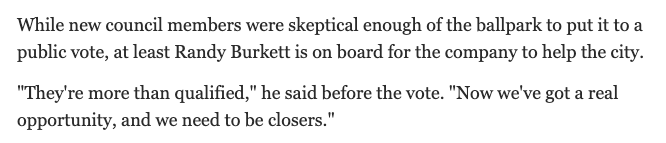
To give the rosy projections of revenue and economic development in Neumann’s deals credibility, he relied on the mystery of how professional sports operate, creating a sense that elected officials considering these plans should trust experts like him. Oftentimes, once he created a proposal, the municipality was also responsible for the cost of outside studies to verify his plans that ”make too much sense.”
Amarillo, TX:
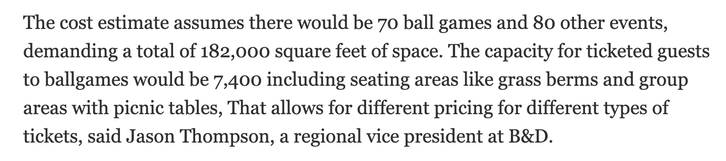
In Amarillo, TX, voters approved $32 million in public funds for a new baseball park on Nov. 3. Eleven days later, Neumann had emailed an elected official about a plan to build a stadium that would attract a better minor league team with a price tag that was $10 million higher than what voters approved. Quotes from Amarillo Globe-News story “Downtown Baseball Stadium Now Estimated at $48.4M” and “AA Basebal Team and High-Dollar Park?”


Anderson Township, OH:
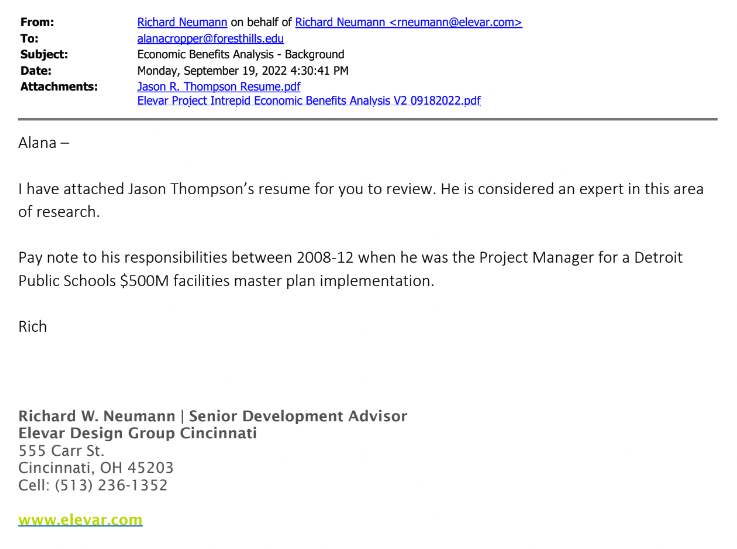
Many questions remain for Neumann’s latest plan, “Project Intrepid.” But we ask you, what’s best for the students of Forest Hills School District? A rushed plan veiled in secrecy that would affect the entire population of the district’s students? Or a thorough accounting of what is necessary and what is possible?
 Advocate FHSD